
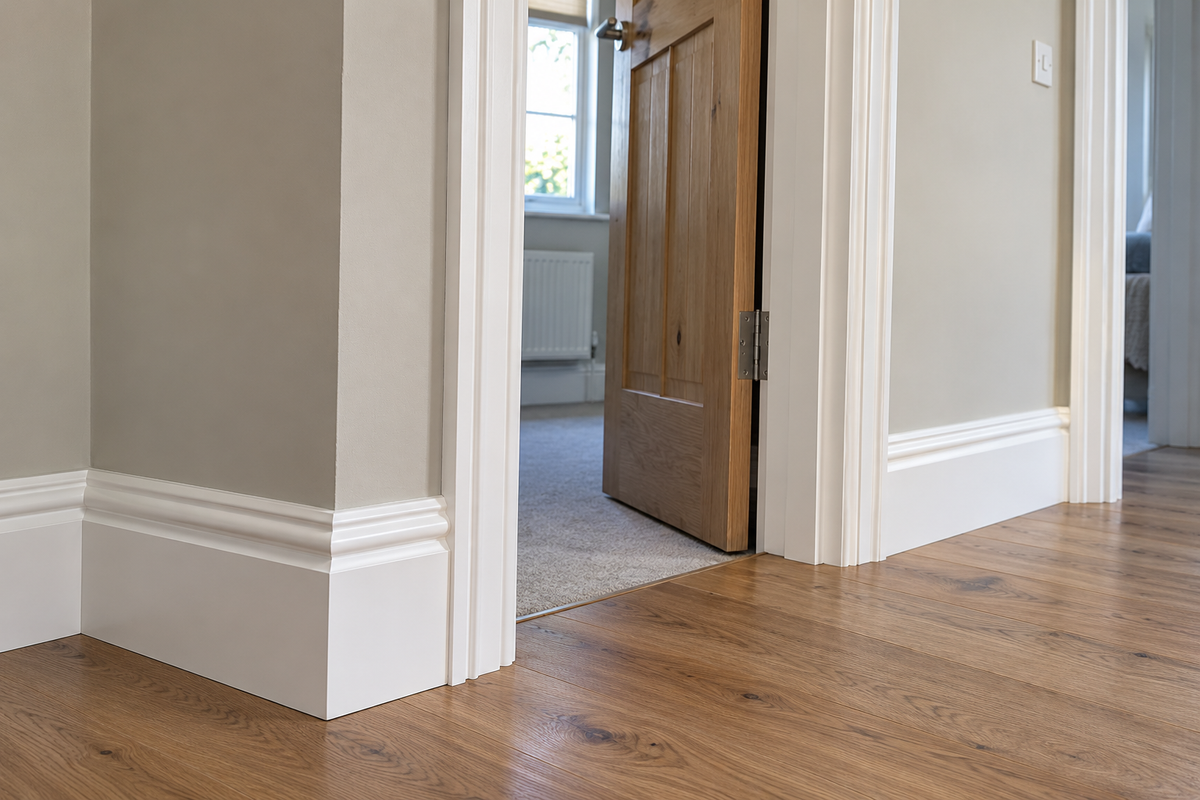
You've finally settled on the flooring, the wall colours are looking good, and you're starting to see your room come together. Then you notice something you hadn't really thought about before.
The skirting boards running along the floor and the architraves surrounding your doors don't quite match.
Is that a problem? Should they have the same design? Or can you mix different styles without making the room look mismatched?
It's a surprisingly common question, especially when you're renovating an older home or replacing only part of the existing woodwork.
The good news is that skirting boards and architraves don't necessarily have to match perfectly. What matters is how well they work together.
And with a little thought about their shape, size, and finish, you can create a lovely, coordinated look without feeling restricted to one particular design.
First, What's the Difference Between Skirting Boards and Architraves?
Before deciding whether they should match, it's worth understanding what each actually does.
Skirting boards run along the bottom of your walls, covering the joint where the wall meets the floor. They help protect the lower wall from everyday knocks, furniture, and cleaning equipment while providing a neat finishing detail.
Architraves do something similar around doors. They frame the doorway, covering the gap between the door lining and the surrounding wall.
Although they serve different purposes, you'll often see them together, particularly where the skirting board meets the architrave at the bottom of a doorway.
That's where the relationship between the two becomes important.
You might not notice a small difference when comparing separate samples, but once everything is fitted and painted, mismatched proportions or noticeably different profiles can become more obvious.
Is It Better to Have Matching Skirting Boards and Architraves?

If you're starting a renovation from scratch, choosing matching profiles is usually the easiest approach.
It gives the room a consistent appearance and removes much of the guesswork involved in selecting different decorative styles.
For example, imagine a living room with freshly painted white woodwork, neutral walls, and wooden flooring.
Choosing a Torus Skirting Board alongside a matching Torus Architrave creates a familiar, balanced look. The rounded detailing continues naturally from the floor to the door frames without drawing too much attention.
If you prefer something more decorative, the same idea works with Ogee Skirting Boards and matching Ogee Architraves.
Their flowing curves can look particularly attractive in traditional interiors, where decorative woodwork already plays a noticeable role.
But here's the important part.
Matching doesn't mean everything needs to be identical in size.
Your skirting boards and architraves can share the same profile while having different heights and widths. In fact, that's completely normal.
The aim is to create visual consistency, not to make every piece of woodwork look exactly the same.
Can You Mix Different Skirting Board and Architrave Styles?
Absolutely.
And sometimes mixing profiles is actually the more practical choice.
Let's say you've moved into a house with perfectly good architraves around every doorway, but the skirting boards are damaged or need replacing.
Would it make sense to remove all the architraves simply because you can't find an identical skirting profile?
Probably not.
Instead, look for a skirting design that complements what's already there.
If your door frames have simple, understated detailing, something like a Square Edge MDF Skirting Board could be worth considering. Its clean profile can work comfortably alongside various styles of existing woodwork.
The same principle applies to more decorative interiors.
You could have traditional Ogee-style architraves alongside relatively simple skirting boards, provided their proportions and finishes feel balanced.
One thing I'd avoid is combining two very elaborate profiles that compete for attention, particularly in a smaller room.
You don't want the skirting and door surrounds to look as though they belong to completely different decorating schemes.
A helpful trick is to place samples next to each other against the wall. It's much easier to judge whether two designs work together when you can see them in the same setting.
Pay Attention to the Size and Proportions

This is where people sometimes get caught out.
You might choose two profiles that look beautiful individually, only to discover that they don't sit comfortably together once installed.
The height of your skirting boards and the width of your architraves both influence how the room looks.
For example, tall skirting boards can look lovely in rooms with generous ceiling heights. But pairing them with very narrow architraves might create an imbalance around the doorways.
In a smaller room, modest skirting boards and appropriately proportioned architraves can feel more natural.
There's another practical detail worth checking: thickness.
Where skirting boards meet architraves, the two pieces need a tidy connection.
If the skirting board projects noticeably further from the wall than the architrave, it can leave an awkward step at the doorway.
This doesn't mean both products must always be the same thickness. However, the junction needs to be considered before fitting.
Sometimes a plinth block at the bottom of the architrave can provide an attractive solution, particularly in traditional interiors.
It's one of those small details that's much easier to plan before installation than to correct afterwards.
Should the Colours and Finishes Match Too?
Now imagine you've chosen two complementary profiles, but the skirting boards are painted bright white while the architraves are finished in a noticeably warmer cream.
Depending on the room, that contrast might look intentional. Or it might simply look as though one section hasn't been repainted yet.
Using the same paint colour and finish is often the simplest way to bring different profiles together.
For instance, painting both the skirting boards and architraves in the same soft white can make a room feel more coordinated, even when their shapes aren't identical.
But there's no rule saying they must match the colour of your walls.
Some homeowners prefer white woodwork against coloured walls, while others paint the skirting, architraves, and walls in a single shade for a quieter, more contemporary appearance.
If you're aiming for a particularly minimalist look, combining straightforward profiles such as Square Edge Architraves with similarly simple skirting boards can help achieve that clean, consistent finish.
The key is to make the combination feel intentional rather than accidental.
What If You're Renovating a Victorian or Period Home?
Older British homes can be particularly interesting when it comes to interior woodwork.
You might find tall skirting boards in one room, decorative architraves in another, and several different profiles throughout the property.
That's not unusual. Previous owners may have replaced individual sections during renovations over the years.
If you're working with original features, take some time to examine them before ordering replacements.
Look at the decorative details, the height of the existing boards, and how the architraves meet the skirting.
For homes with traditional decorative features, Victorian MDF Skirting Boards and Victorian Architraves are two options worth comparing against the existing woodwork.
Their traditional styling can complement period-inspired interiors, particularly when the room already has decorative architectural details.
But don't assume that every Victorian or Edwardian home needs heavily decorative mouldings.
Some traditional interiors look perfectly balanced with relatively simple profiles.
It's often more useful to follow the character of the existing house than to choose a particular design purely because it's labelled traditional.
A Few Things to Check Before You Order
If you're replacing skirting boards and architraves together, it's worth getting a few details right before making your final decision.
Start by looking at the overall style of the room. Are you trying to keep things clean and understated, or would you prefer more decorative woodwork?
Next, consider the dimensions. Check the height of the skirting boards, the width of the architraves, and how their thicknesses will work together at the doorways.
If you're keeping existing woodwork, compare samples against it rather than relying entirely on online photographs.
And don't forget about the finish.
Choosing products in compatible materials and preparing them consistently for painting can make the finished result look much more cohesive.
One final suggestion: if you're planning to replace both, choose the skirting boards and architraves at the same time.
It's easier to make small adjustments to your choices before anything has been fitted than to discover a mismatch halfway through the renovation.
Frequently Asked Questions
Do Skirting Boards and Architraves Have to Be the Same Profile?
No. Matching profiles create a consistent appearance, but different designs can work together when their proportions, decorative details, and finishes complement each other.
Should Skirting Boards and Architraves Be the Same Colour?
They don't have to be, although using the same colour is often the easiest way to achieve a coordinated finish. Contrasting colours can also work when they're part of the room's overall decorating scheme.
Can I Replace Skirting Boards Without Replacing Architraves?
Yes. If your existing architraves are in good condition, you can leave them in place and choose new skirting boards that complement their style. Just check the profile and thickness where the two meet.
Should You Fit Architraves or Skirting Boards First?
When replacing both, architraves are generally fitted first. This allows the skirting boards to be measured and cut neatly against the finished door surrounds.
Final Thoughts: Matching Is Helpful, but Not Essential
When it comes to choosing skirting boards and architraves, you don't need to follow a strict rule.
Matching profiles are a reliable choice, particularly when you're renovating an entire room and want everything to feel consistent.
But if you're working around existing woodwork, mixing complementary styles can look just as good.
Pay attention to the proportions, the way the two profiles meet, and the finish you're planning to use.
And if you're still unsure, compare a few samples in the room itself. What looks perfect in a product photograph can feel quite different once it's placed against your walls.
Ultimately, the best combination is the one that feels natural in your home, whether every profile matches perfectly or not.